Our Wharton economics professor, Kent Smetters, runs one of the more respected fiscal models in the country and has served at the highest levels of government — deputy assistant secretary for economic policy at the US Treasury. Asked what we can do about the US debt trajectory, he gave a tongue-in-cheek but ominous answer: buy land.
It sounds like a joke until you read what his own shop has published. The Penn Wharton Budget Model puts the outer bound of sustainable US debt at about 210 percent of GDP — a ceiling reached inside about two decades on current policy, with a one-in-four chance of arriving within fourteen years. Past that bound, in the model’s words, “there is no feasible future additional tax on broad-based labor income that can finance the interest payments at the returns demanded by financial markets.” That is not a warning about hard choices. It is a statement that past a certain point, the choices stop existing.
He’s not wrong about the land, either. Tangible assets are the oldest hedge there is, and they have positioned their owners to outlast countless downturns, recessions and depressions.
But unless you can afford enough land to replicate some feudal eco-village utopia — with a defensible perimeter — and even if you can, the hedge has a hole in it. It assumes the ground under the land stays stable. Given the choice, I’d weight where the land is more heavily than what’s on it. And I don’t mean California versus Texas. I mean the where on a global scale.
Which makes it worth looking at the passports currently for sale.
The options are plentiful, provided you’ve got some resource set aside. You could chase the sun with Portugal’s D7, or its perpetually shifting Golden Visa rules, though you’ll be navigating the labyrinthine bureaucracy of a Southern European state that would likely get embroiled in whatever conflict its Western allies are caught up in. Similarly, Italy’s Elective Residency, provided you enjoy the proximity of a volatile Mediterranean theatre. You might even look to Scotland via the Global Talent or Ancestry routes, which offers charm but remains tethered to the post-Brexit uncertainty of the United Kingdom.
By contrast, only one country’s residency would withstand a comprehensive battery of catastrophic risk scenarios. New Zealand’s Active Investor Plus visa is a different species of asset: a hedge into a country that ranks in the global top five for the rule of law, sits in a different hemisphere from every major flashpoint, and maintains a form of political stability alongside social wellbeing that is now a rare commodity in the West.
For me the choice isn’t only about metrics. It’s about roots. As a California-born Kiwi with five generations of family in the South Island, I’m lucky enough not to have to buy my way in — and I’m investing more than most in making sure the country stays as strong as it has been for the people betting the farm on it in their second act.
My own hedge against the doomsday debt clock wasn’t just to buy land, or gold, or put a bunker in the ground. I did some of that around the time of the Covid pandemic — only to discover the limitation of where that land was: in a country under strict lockdown. Meanwhile my friends and family in New Zealand were, rather smugly one might argue, posting photos from festivals and gatherings, apparently having the time of their lives. The land appreciated nicely. I would have traded every dollar of that appreciation for the ability to stand in a crowd.
So for anyone with the foresight to look decades ahead, I offer a 2026 revision to Smetters’ lecture: buy a passport. Preferably one to a place where your family actually wants to be if the US exhausts its options or attempts to inflate away its debt, debasing the currency in the process. Even if you subscribe to the church of technologicism, believe in a sudden return to fiscal sanity, or simply don’t want to relive post-war economic repression, mobility remains the ultimate insurance policy. If you’re the type to bring a rain shell when the forecast looks mild — hope for the best, plan for the worst — then New Zealand’s borders are open to you to an unprecedented degree right now.
But buying the passport is the beginning, not the end. The next question is mechanics: how do you buy it, what does it cost, and what happens to the money once it lands? And a harder one behind it — what do you want that money to do, in a place you intend to call home?
Because a passport nobody uses is expensive insurance, and land nobody works is a bet with a view. Both are static, and static positions do nothing for the place they’re parked in. The version that actually works is a third thing: own something that produces, somewhere the ground under it is stable.
Before we go down that road, let’s look at the underlying assumptions with more rigour.
I. The clock
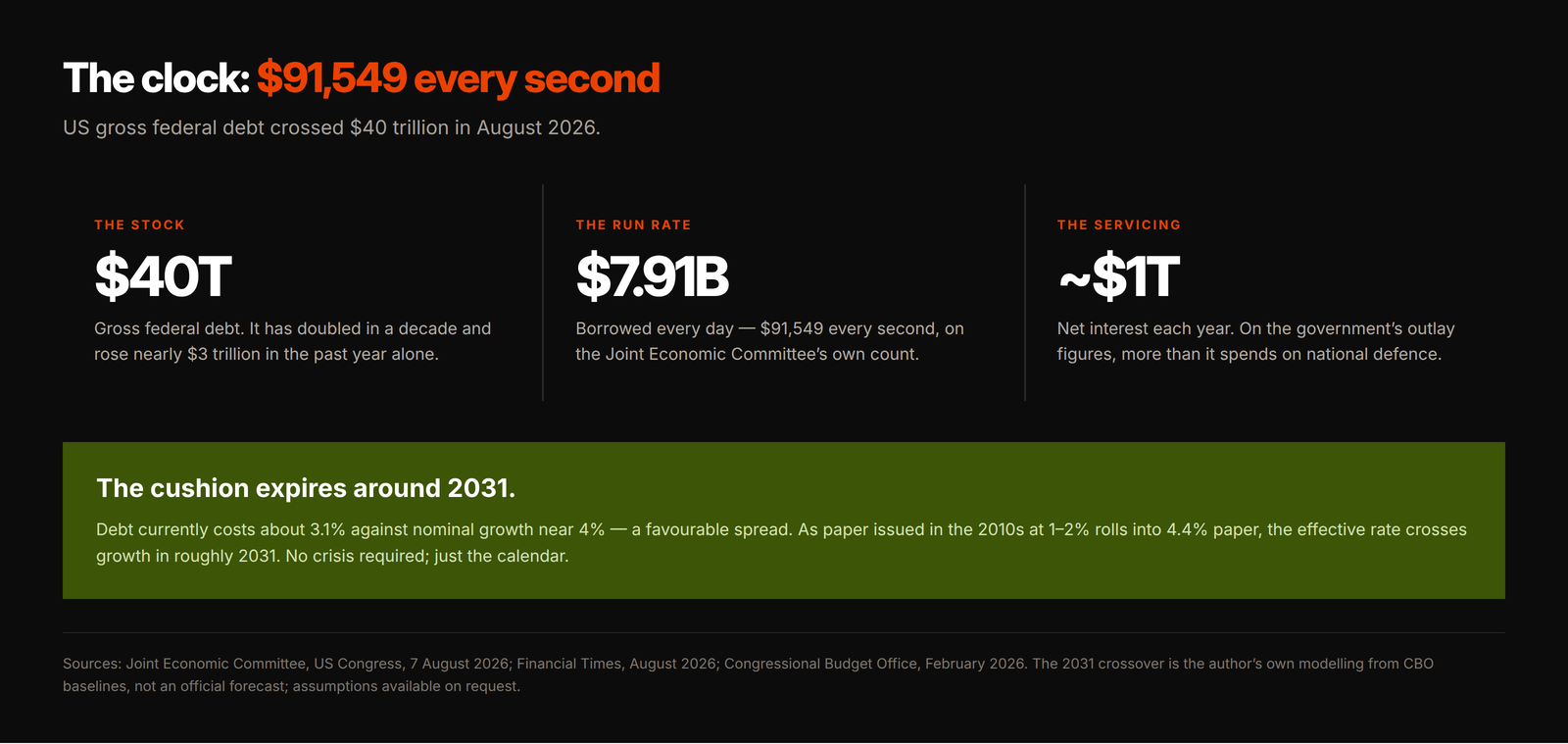
US gross federal debt crossed $40 trillion this week. It rose nearly $3 trillion in a single year, the fastest pace outside the pandemic, and it has doubled in a decade. Debt held by the public exceeds $32 trillion, roughly the size of the American economy. Congress’s own Joint Economic Committee clocked the run rate in early August at $7.91 billion a day: $91,549 every second. A senior policy director at the Committee for a Responsible Federal Budget called it, to the Financial Times, a “gigantic flashing ‘check engine’ light.”
Reading this essay takes about a quarter of an hour. In that time, the debt grows by roughly $80 million.
The striking part isn’t the magnitude. It’s that the trajectory has survived every administration that promised to bend it. The current president returned to office pledging to curb wasteful spending, with a Treasury Secretary targeting a 3 percent deficit. Cuts in some areas were offset by tax legislation projected to add $4 trillion by 2034 and an FY2027 defence request of $1.5 trillion, the largest in dollar terms in American history. The deficit sits near 5.8 percent of GDP. Both parties have skipped the same opportunity in turn, and the deficits are running at roughly $2 trillion a year during a period of relative economic strength. The stress case hasn’t arrived yet.
Higher debt means lenders demand more to hold it, which raises servicing costs, which requires more borrowing. This is why the debt curve bends upward rather than running straight.
Last week the US paid its highest 30-year borrowing costs since 2001, and the Treasury moved to double its purchases of long-term debt to steady a market that was selling off. Ed Yardeni’s description in the FT was two words: “vicious cycle.”
Net interest now runs to roughly a trillion dollars a year. On the government’s own outlay figures, that is more than it spends on national defence.
The clock that actually matters
Here’s the part nobody has put on a slide yet, and it’s my own modelling off CBO baselines rather than anyone’s official forecast.
The effective interest rate on America’s debt is currently about 3.1 percent: a trillion dollars of interest against $32 trillion of debt. Nominal GDP grows around 4 percent. That relationship, r below g, is favourable. It means the debt burden should be shrinking relative to the economy, absent deficits.
That cushion expires around 2031.
Average maturity is roughly six years, so about a sixth of the stock reprices every year, and bonds issued in the 2010s at 1 to 2 percent are rolling into paper at 4.4 percent. The effective rate climbs to 3.9 percent by 2030, crosses nominal growth in 2031, and settles near 4.4 percent. No crisis required. No policy error. Just the calendar.
And the ratio rises anyway, before and after: 101 percent of GDP today, 111 percent by the crossover, 120 percent by 2036, 175 percent by 2056. The favourable r versus g was never saving anything, because the primary deficit swamps it. Closing that gap requires a permanent swing of 2.6 to 3.6 percent of GDP: between $830 billion and $1.14 trillion, every year, forever.
For scale: US national defence for FY2026 runs to about $1.05 trillion. The stabilisation gap brackets it. Closing the debt means finding the entire defence budget, annually, permanently, through cuts or taxes or both.
Four exits, and the one everyone assumes will happen
That arithmetic resolves four ways: cut spending, raise taxes, inflate the burden away, or hold interest rates below inflation and let bondholders absorb it quietly.
Most people assume inflation does the work. One of my macro professors pushed back hard on that, and the modelling proves him right. Doubling inflation from 2 to 4 percent for a full decade improves the debt-to-GDP ratio by about 8 points. Tripling it to 6 percent buys 15. Neither stops the rise.
The reasons are structural. Average maturity on the debt is six years, so repricing outruns erosion. Roughly a fifth of the stock is T-bills that reprice instantly. About 8 percent is inflation-indexed and immune by construction. New issuance gets repriced by the Fisher effect the moment inflation is expected. And roughly two-thirds of federal outlays are themselves indexed, so the primary deficit is close to inflation-neutral. Inflation is a one-time revaluation of existing fixed-coupon debt, not a policy. It costs everyone something and solves almost nothing.
What actually worked, the last time a country in this position dug out, was the fourth option. From 1945 to 1980, the US held nominal rates below inflation for three decades and the bondholders paid the bill slowly, without ever voting on it. Run that in the model and it’s transformative: 4 percent inflation with a negative 2 percent real rate takes debt to 93 percent of GDP by 2036 instead of 125. A 32-point swing, against 8 from inflation alone.
Financial repression has exactly one requirement: capital that cannot leave. Banks compelled through capital rules, pensions through mandates, a central bank buying, households behind a closed capital account. America had all of that in 1950. It has none of it now.
Which is the whole argument in one line: mobility is the only asset class repression cannot reach.
II. Seven hundred households already ran this math
And they’re running toward the bottom of the world.
More than 700 people have applied for New Zealand’s Active Investor Plus visa in fourteen months, against 115 in the two and a half years before that — a thirteen-fold jump in the monthly run rate, triggered by dropping the Growth category threshold from NZ$15 million to NZ$5 million. NZ$4.8 billion pledged, averaging just under NZ$6 million each. Against a roughly NZ$450 billion economy that’s about 1.1 percent of GDP in fourteen months. Scaled to the United States, the equivalent would be US$340 billion.
About a third are American. Californians especially.
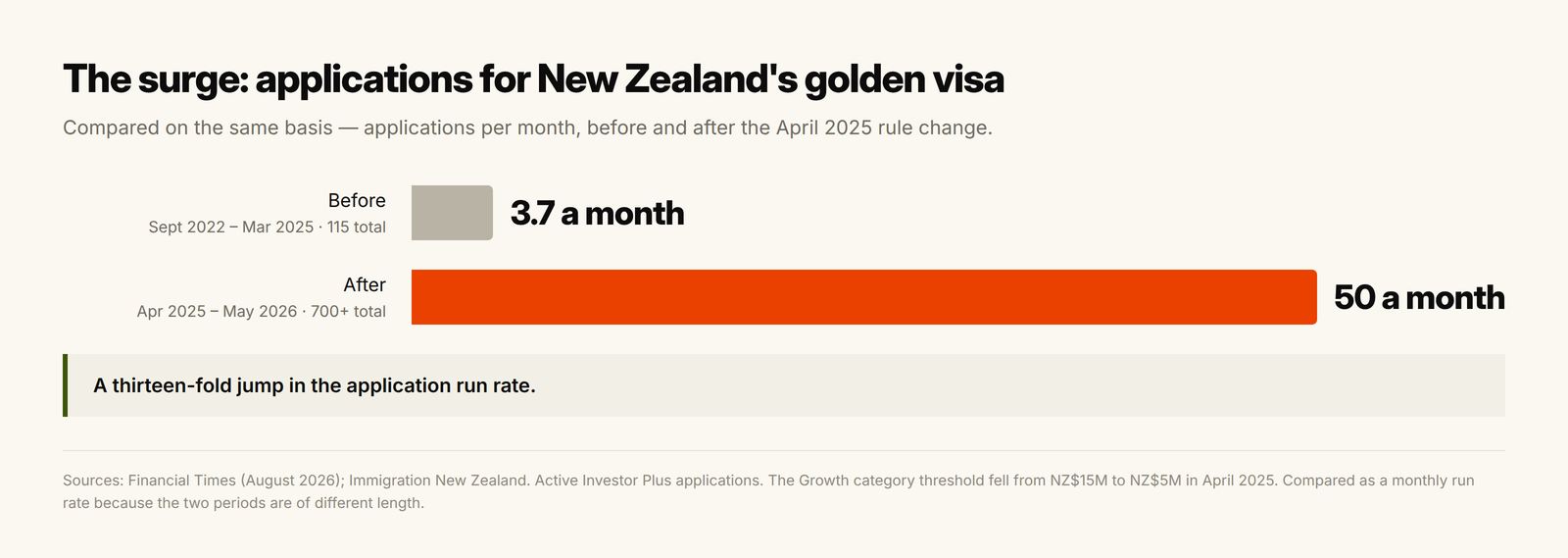
New Zealand didn’t suddenly become more desirable. It found investors’ reservation price and set the entrance fee closer to the mean willingness to pay — which appears to be roughly the cost of a house in any of the wealthiest cities on earth. A small price, I’d argue, for permanent access to a country that ranks among the most stable, least corrupt and most liveable on the planet, with rule of law in the global top five.
But the reason it works as a hedge isn’t the scenery. It’s that the risks are uncorrelated: different currency, different politics, different hemisphere, different demographic clock. A second base is only worth having if its bad years aren’t the same as the first one’s bad years.
And the FT gave the thesis its perfect quote without meaning to. Courtney Andelman, a Santa Barbara venture investor who took the visa, put it this way: “How to make every dollar achieve its highest and best use is a question we constantly ask ourselves. If New Zealand doesn’t offer the best value, we’ll go somewhere else. Every one of those dollars is mobile.”
Read that again with Movement I in mind. That isn’t a rich family’s preference. That is the binding constraint on the state’s cheapest exit. Repression works only on captive money, and hers isn’t.
I’m one of the people making this move, though from the other direction: a California-born Kiwi who grew up between boarding schools on the East Coast and Nelson, with five generations of family at the bottom of the South Island. I’m not arriving. I’m going home. But I understand why so many have chosen to make the leap, and I’m well placed to support them before, during and after they — and their capital — arrive.
III. The money has arrived. Where is it going?
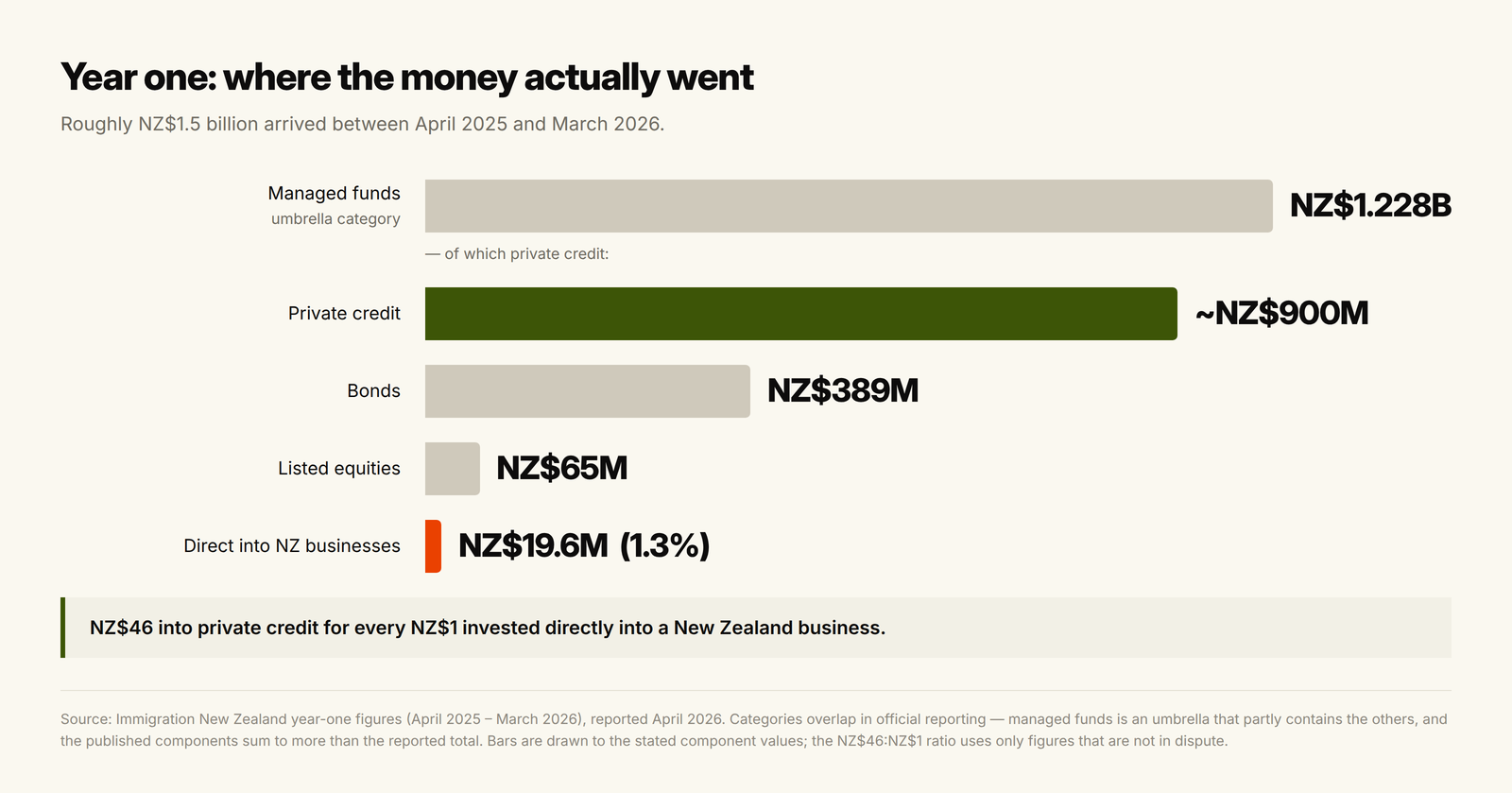
The official year-one figures are out. Between April 2025 and March 2026, roughly NZ$1.5 billion arrived. Of that: $1.228 billion into managed funds, around $900 million of it private credit. $389 million into bonds. $65 million into listed equities.
And $19.6 million into New Zealand businesses directly.
Before the ratios, one thing worth getting right, because most commentary on these figures gets it wrong. The visa has two categories and they don’t play by the same rules. Growth takes NZ$5 million for three years and permits exactly two destinations: managed funds, or direct investment into a New Zealand business. Balanced takes NZ$10 million for five years and opens the door much wider — bonds, listed equities, property development, philanthropy. Bonds and listed equities are not acceptable Growth investments at all.
Which means the $389 million in bonds and the $65 million in equities was never eligible to go into a New Zealand company in the first place. Criticising it for not doing so is criticising it for obeying its own rulebook. Set it aside.
What’s left is the money that faced the actual choice. Of the capital that went into the two destinations the Growth category permits, direct investment took 1.6 percent. Managed funds took 98.4.
That’s the number that should sting — not because investors did anything wrong, but because this is the category the government built specifically to move capital into New Zealand businesses. It offers precisely two doors. Better than ninety-eight cents in the dollar went through the one that never requires you to meet a New Zealand business owner.
And here’s the cleanest way to put it, needing no denominator at all: for every dollar that went directly into a New Zealand business, roughly forty-six went into private credit.
A note on the arithmetic, because I want it to survive contact with a sceptic. Official reporting doesn’t reconcile. The published components sum to NZ$1.70 billion against a stated total quoted variously at NZ$1.4 billion and NZ$1.49 billion — a gap of about NZ$212 million. Some of that is likely double-counting: a managed fund that holds bonds gets counted in both lines. Which is one more reason to distrust any single percentage of the whole pool, and to work from the ratio instead. The NZ$19.6 million isn’t disputed by anyone.
A whole year of golden-visa direct investment into actual New Zealand companies comes to less than the price of four visa-qualifying Queenstown houses. Put it against the clock from Movement I and it’s smaller still. NZ$19.6 million is about US$11.7 million. At $91,549 a second, that is what the United States borrows every two minutes.
Full disclosure before I criticise the cargo: Kea Capital Partners is built to be one of those managed funds, pending Invest New Zealand approval. The channel is fine. For most families it’s the only realistic door. The question is what’s inside.
The not-so-hidden risk to New Zealand
Advisers are doing their fiduciary duty and directing AIP investors toward lending funds that match a three-year visa hold better than a seven-year equity cycle, preserve capital, and explain easily in a meeting. Private credit is rational, defensible and — at least in the short term — safe.
But run the clock on it. Three-year money makes three-year decisions. Nobody builds much that endures when capital has to be returned before year four. The private-credit funds can’t extend, because their own investors have been promised their money back at the hold’s end. One private-credit co-founder, whose funds are largely owned by AIP investors, has told the NZ Herald he already structures against a redemption run. But how?
The data shows roughly $900 million of visa-backed lending marching toward the same window. If the pledged $4.8 billion follows the same pattern, call it $3 billion — a great deal of capital flowing into private lenders’ coffers that will have to flow back out of the businesses they’re lending to. If borrowers can’t repay or refinance, in a banking system the Immigration Minister herself describes as asset-based, we end up with synchronised defaults. If they can, principal plus interest flows back out of the productive economy to lenders who are most likely not in New Zealand — which ultimately hasn’t done much for the country whose citizenship they can now hold.
Heads the businesses bleed, tails the money leaves. As a Kiwi-American who sees both sides of this transaction and cares about both, I reckon we can and must do better. And since the programme is still hitting investors’ reservation price, the only thing that needs to change is the mechanism.
Equity is the opposite instrument. It stays in the business, compounds in the business, and what it builds stays in the country. Yes, there’s a dilution effect for owners — but it also means shared skin in the game, aligned incentives, and a long enough horizon to create jobs and support New Zealand for the long run.
The government has noticed. Invest NZ already closed an avenue that let visa money sit in cash, citing the need to align the Growth category with active investment. When a programme named Growth requires a rule change to produce growth, the drift is official.
What the future holds for New Zealand business
Owners are ageing out, and few have succession plans. Combine ageing founders with a purported brain drain and you have a problem ripe for resolution through this visa programme. More than half of small-business owners are now over 55, and fewer than one in three have a documented exit plan.
Japan has already run this experiment. Its government has been warning about it for years as the 2025 Problem: 2.45 million owners over 70, 1.27 million with no successor, one-third of all Japanese companies, with 6.5 million jobs and ¥22 trillion of GDP at risk. Roughly 4 percent of the economy, scheduled for deletion by demographics. In 2024 a record 62,695 Japanese firms shut down — and 51.5 percent of them were still profitable when they did. Roughly eighty-eight solvent businesses closing every day. They didn’t run out of money. They ran out of people. The result wasn’t a crash; it was three decades of an economy that stopped compounding. Apply Japan’s 4 percent to New Zealand and the bill is north of NZ$15 billion.
New Zealand is not Japan, and the difference is that our door is open. Japan aged with near-zero migration and no valve. New Zealand is accessible, and the AIP visa is that valve at full open to those who can afford it. Japan spent thirty years trying to conjure this kind of inbound capital and couldn’t. New Zealand has it queuing at the border with chequebooks out — and is putting about one and a half percent of it to work.
Meanwhile AI brings both threat and opportunity, for white- and blue-collar businesses alike. No model crimps a sprinkler fitting or crawls a ceiling cavity. But it can make a back office profoundly more efficient and free ageing founders to do what they’re best at and what they actually enjoy: the quoting, scheduling, compliance paperwork, monitoring, invoicing. Rarely do we see ageing operators adopting it with alacrity — they need an injection of capital and energy to do so. Operators who don’t keep up will bleed margin until a competitor beats them or a platform absorbs them.
Which is precisely why a three-year loan is the wrong instrument. Adaptation is a capital expenditure with a decade-long payoff. Lending against it and demanding repayment before the transition completes is a way to guarantee the failure it was meant to prevent.
IV. The trade
The competition these businesses need to win isn’t against the shop across town. It’s against an intelligence revolution nobody has seen the likes of, and New Zealand business will be caught sleeping if we don’t adapt. It’s also against a cultural norm that keeps the country small — you may have heard of the tall poppy syndrome, and helping our business owners overcome it is exactly the job.
So let me be honest about what we are, because “champion of small business” isn’t quite it. We turn small businesses into big ones, on purpose, and there’s a certain psychology needed to grow from “man in a van” to platform, or national leader. Consolidation is what funds adaptation: shared systems, shared compliance, shared technology, spread across enough revenue to actually pay for them. Someone has to shake the tree in every sector. In ours, that’s the job we’ve taken: catalyst, not conqueror.
There’s a wrong way to do this, and it’s earned private equity its reputation. By the Private Equity Stakeholder Project’s count — an advocacy group and no friend of the industry, but the arithmetic is checkable — PE-backed firms accounted for half of the corporate bankruptcies above $1 billion in the first half of this year, while representing about 7 percent of the economy. Much of that was debt-fuelled roll-ups that bought good businesses, loaded them with leverage, ran them hard for a fast exit and left the wreckage behind. Hand a life’s work to the wrong buyer and there’s no legacy, just a liquidation with better branding.
A Queenstown club owner, a fifth-generation farmer who ran a multi-billion-dollar construction business before coming home, put the country’s whole opportunity in one sentence to the Financial Times: “How do I make the person that spent NZ$5mn want to invest NZ$500mn?”
That’s a 100x multiplier, and it’s the actual prize. Not the entry fee: the second cheque, the third, and the operating company bought in year four because someone fell for the place and met the people.
Why me
I went to Silicon Valley to build something that mattered, and did. I also got swept up in it — the single-minded pursuit of greatness measured against a goal that kept moving. Balance went first, then wellbeing, and I made both trades without noticing. The scoreboard kept working. The peace never turned up. It turned up later, in the mountains: Tahoe, then Boulder, where nobody keeps score.
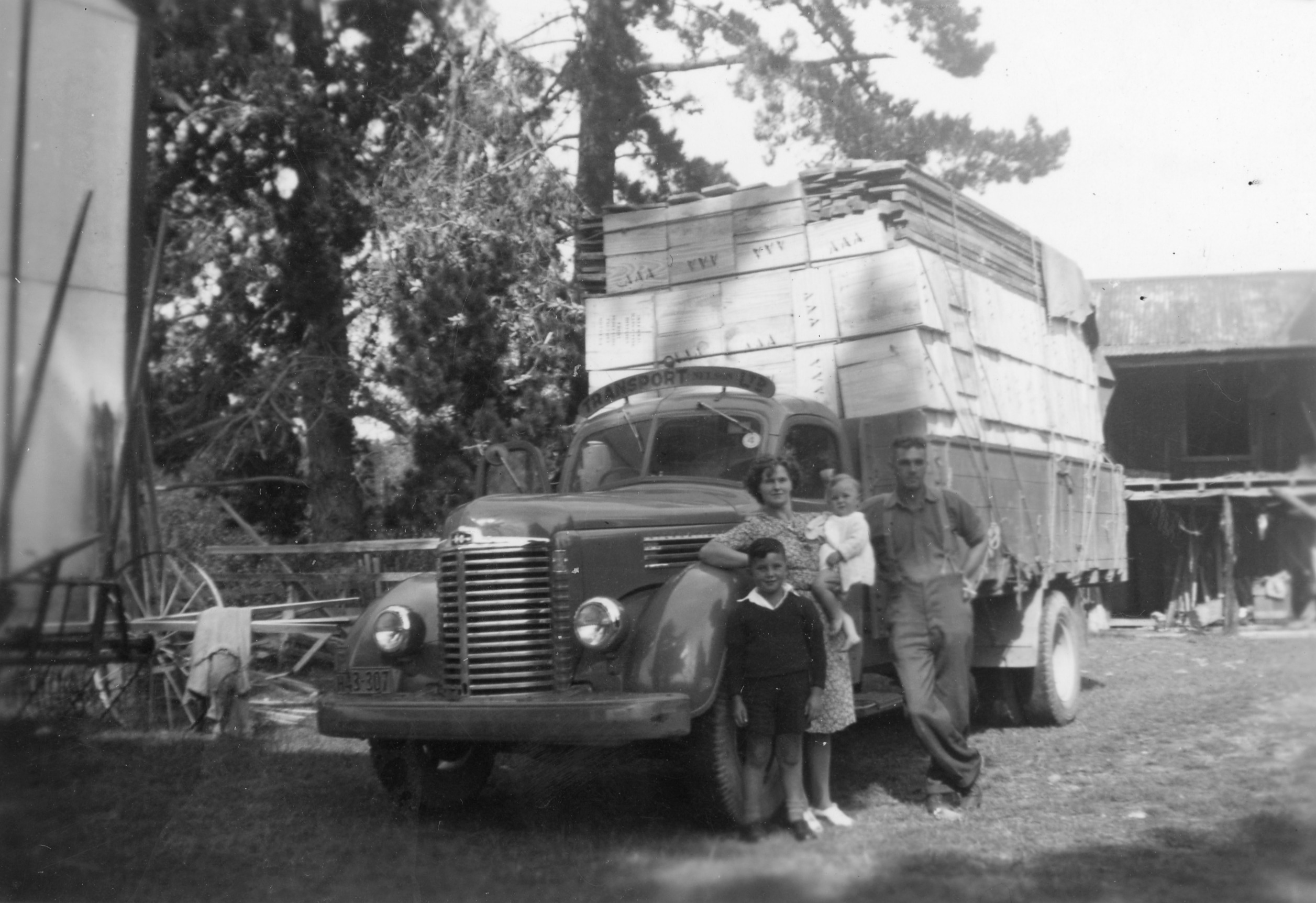
My father made a different trade and made it work. He drove trucks in New Zealand and Australia, left the truck yard and went all the way: one of the most-cited economists alive, a consulting firm he co-founded taken public more than once, a career spent teaching the world’s largest companies how to adapt or die. He’s riding the current wave as I write this — AI, digital twins, expert systems. What the trucking years gave him wasn’t a trade. It was risk appetite, and the freedom to go all the way with a thing.
I had every ticket to ride that same wave. East Coast schools, the Ivy League, a father whose life’s work is literally the theory of how firms adapt. I’m turning back instead — toward the workshop, the port, the sprinkler line. Not away from the intelligence revolution: toward the businesses that will be flattened by it unless somebody arms them. He teaches adaptation from the podium. I intend to install it.
Behind him, five generations: farmers, then truckers, then mechanics. The old-timers still talk about the Christmas my grandfather drove his tanker through a storm for hundreds of kilometres because the town had run out of beer. My cousins keep a working port moving today. The throughline across both branches, the professor and the mechanics, never changed: value comes from building the real thing well, not extracting from it. Nobody in my family has ever stripped anything for parts. It wouldn’t occur to them.
So the strategy is an integration: five generations of blue collar, one generation of dynamic capabilities, and the rigour to weld them into a single thesis. Buy the essential, unglamorous businesses that keep New Zealand safe and running. Back them patiently, because building takes longer than a visa clock, and without the leverage that turns a good company fragile. Keep the good people. Give founders a dignified way to hand off their life’s work. Not a fire sale. Not a slow fade. A handoff.
Plan B is also Plan A
Dual and trans-citizenship is the next frontier of portfolio construction — but it’s been my entire life. A second base whose downside scenarios don’t correlate with the first is a privilege I’ve always had, though the choice seemed binary until very recently. It took me thirty-five years to see it and act: there are pros and cons to every country, so why make it zero-sum when you can have the best of both?
There’s a charge that comes with all of this and it deserves an answer: leaving a country while it struggles looks like desertion. Rat, sinking ship. Money always runs, because that’s what money does.
Two answers. First, home is where our people are, and mine have been in New Zealand for five generations. Going back isn’t fleeing. It’s the shortest distance between me and my own family’s centre of gravity.
Second, and more usefully: this was never a choice between countries. No sophisticated family holds a single currency, a single asset class or a single jurisdiction for their capital, then holds exactly one for their life. One passport, one tax regime, one political system, one set of assumptions about the next thirty years — that’s an undiversified position with everything in it.
And there’s a dimension the spreadsheets miss: wealth and health are the same portfolio. When health goes, the wealth becomes irrelevant, which amounts to the same thing. Any model that optimises returns and quietly destroys the people holding them has miscalculated, whatever the IRR says. I learned that the expensive way — and I learned the rest of it locked down on a piece of appreciating land I couldn’t leave.
A hedge is only as good as the place being hedged into. Anyone treating New Zealand as a safe-deposit box with a view has a self-interested reason to want its essential businesses surviving the next twenty years, its ports running, its towns still employing the crews that keep them working. Building the place is how the hedge stays worth holding.
$91,549 a second isn’t a reason to panic. It’s a reason to have a second base, and a reason to make that base worth living in.
The ask
To the owners of essential businesses staring down the succession question with no good answer: I’d like to talk. Not to pitch. To listen, and to understand what’s been built and what its builder wants it to become.
And to the others arriving: everyone on this visa is conspicuous by definition. New Zealand has a phrase for what happens to conspicuous people, and the mower is real. We show up without the rounded vowels, with too much money and too many opinions about how things could be done better, and the country watches to see whether we’re here to belong or here to extract.
I intend to belong. That means learning the place rather than importing a replica of the one I left, showing up in the community, and putting capital into things that outlast me.
Smetters was right. Buy land. Buy a passport too.
Then buy something that makes something, and stay long enough to see what it becomes.
— Teddy Teece (Nelson, NZ & Boulder, CO)
Teddy Teece is the Managing Partner of Kea Capital Partners, a New Zealand firm backing the essential, blue-collar businesses — fire protection, building compliance, and the trades — that keep the country safe and moving. Five generations of the Teece family have farmed, trucked, and turned wrenches in New Zealand. More at teddyteece.com .
Kea Capital Partners is available to wholesale investors only under the Financial Markets Conduct Act 2013. Nothing on this page is an offer of any financial product, financial advice, or immigration advice.
Kea Capital Partners is not a licensed immigration adviser or financial adviser. Nothing we publish is immigration, financial, legal or tax advice. Please seek advice from a licensed professional before making any decision.
The numbers behind this argument, with full sources: Where New Zealand’s Golden Visa Money Actually Went →
Sources
- US government debt hits $40tn as borrowing rises at historic rate — Financial Times, August 2026
- ‘Every dollar is mobile’: California’s rich snap up New Zealand ‘golden visas’ — Financial Times, 5 August 2026
- National debt reaches $39.83 trillion — Joint Economic Committee, 7 August 2026
- When Does Federal Debt Reach Unsustainable Levels? Spring 2026 — Onward — Penn Wharton Budget Model, June 2026
- Active Investor Plus visa cash rules under review amid idle funds concerns — NZ Herald, April 2026
- AIP visa draws in nearly $4b of foreign funds in first year — RNZ, April 2026
- Active Investor Plus programme data — Immigration New Zealand
- The Budget and Economic Outlook: 2026–2036 — Congressional Budget Office, February 2026
- The Great Ownership Transfer — McKinsey Institute for Economic Mobility, February 2026
- Japan’s succession problem — World Economic Forum, April 2025
- 2024 business closure data — Tokyo Shoko Research
- Private equity and 2026 bankruptcies — Private Equity Stakeholder Project
- Active Investor Plus (AIP) Visa — Charting the course — MinterEllisonRuddWatts, June 2026
Debt modelling (the 2031 crossover, the stabilisation gap, and the inflation-erosion figures) is the author’s own, built from CBO baselines. Assumptions available on request.